
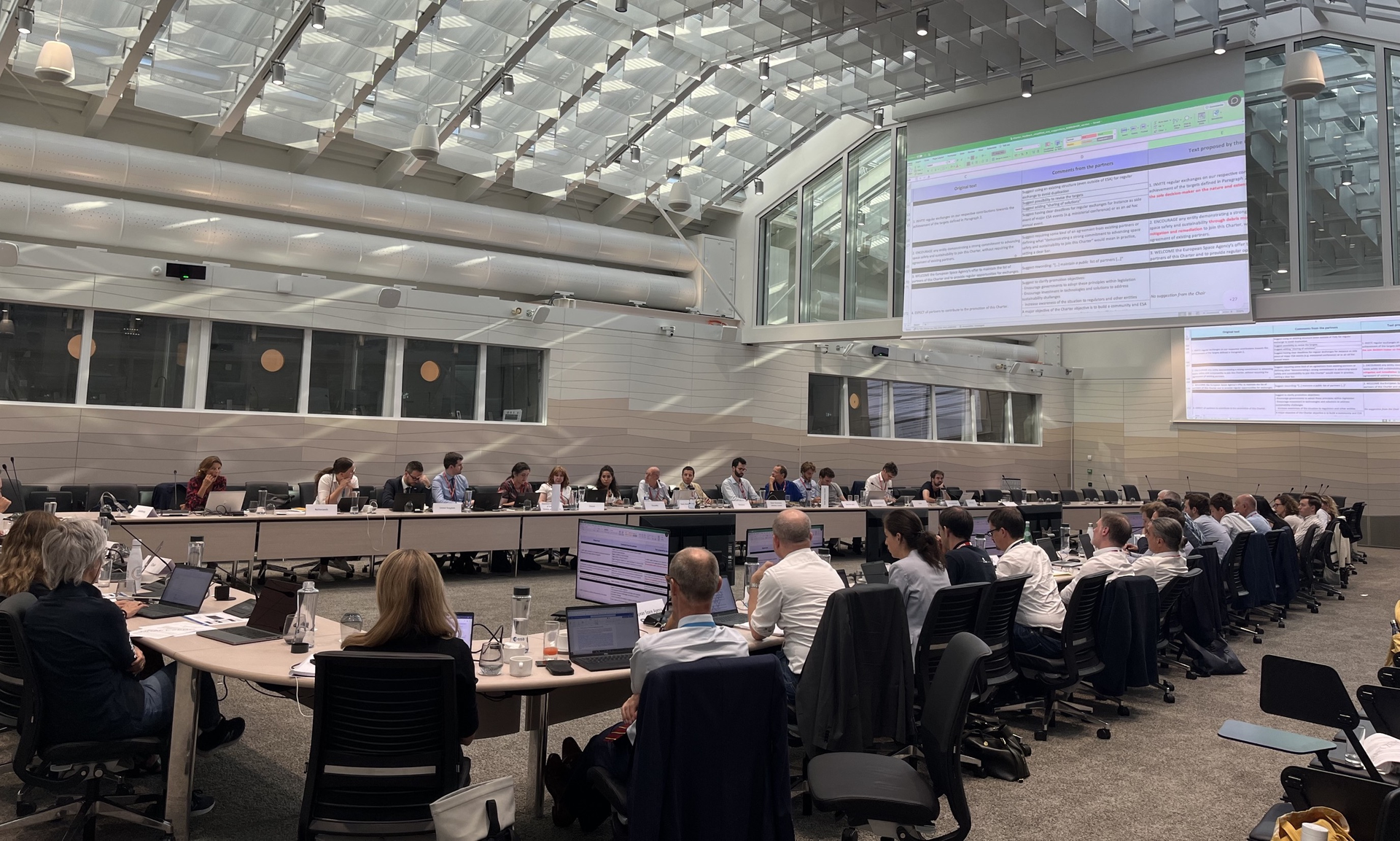
Developed by the community, for the community, the Zero Debris Charter outlines an ambitious vision to guide the space sector toward a Zero Debris future. Created in 2023 and officially released the same year, it received its first signature in 2024.
Since the beginning of 2025, its momentum has continued to grow, with 21 new signatories joining, bringing the total to 166 across 33 countries, including 20 states.
In Q1 2025, the Charter gained further momentum through a series of signature events:
Winter Satellite Workshop 2025 – Helsinki (21-23 January 2025): The Charter welcomed 9 new signatories, with a significant highlight being the Finnish Minister of Economic Affairs’ official endorsement, making Finland the 19th country to join the Zero Debris Community.
Czech Republic joins (29 January 2025): Another key moment came as the Czech Republic became the 20th state to sign the Charter, accompanied by 5 additional signatures from both public and private Czech entities.
The growing number of signatories underscores the rising recognition of space debris as a critical challenge and strengthens the Zero Debris Community’s capability to drive impactful change across the global space sector.
Zero Debris Charter : https://esoc.esa.int/sites/default/files/Zero_Debris_Charter_EN.pdf#msdynttrid=iuw4s_AB2d9ynxzd5YAqy4SQ2RvrqrWSQgAJWivFezQ
The release of the Zero Debris technological ‘To-Do List’
Achieving Zero Debris by 2030 requires concrete technological solutions—many of which are still missing. To bridge this gap, the Zero Debris Technical Booklet was released to the public on 15 January 2025.
It is an exhaustive repository of needs, technical solutions and key enablers gathered through the Zero Debris Community to achieve, by 2030, the jointly defined targets listed in the charter. It is structured around six technical chapters, each addressing a key aspect of debris mitigation.
Find out more about the booklet: ESA – Technological ‘to-do list’ to reach Zero Debris created: https://www.esa.int/Space_Safety/Technological_to-do_list_to_reach_Zero_Debris_created#msdynttrid=3s5cxHpCjD6oAnUYGwaY0Ux4R4oKRxyRh1Ya0InYzJo
Interested in discovering its content? Read it here: Zero Debris Technical Booklet : https://esamultimedia.esa.int/docs/spacesafety/Zero_Debris_Technical_Booklet.pdf#msdynttrid=2IaqkwgNHG-6bAFJ46Kd96jdNKUlZdhD_XzPEK6DcCc
The first Zero Debris Webinar: A Dive into the booklet
On 17 February 2025, the first-ever Zero Debris Webinar gathered the community for an in-depth discussion on the Zero Debris Technical Booklet. The event featured presentations from Astroscale, OHB SE, and ESA, offering valuable insights into the document’s purpose, key challenges, and next steps.
Among the key takeaways of the webinar:
The Zero Debris Technical Booklet has been developed by the Zero Debris community, for the Zero Debris community. It outlines the needs, solutions, and key enablers necessary to achieve the Zero Debris Charter’s 2030 targets.
Rather than prescribing specific methods, the booklet defines what needs to be achieved while leaving the «how» open for industry collaboration—recognising that no single actor can solve the challenge alone. As a living document, it will continuously evolve to reflect technological progress and community insights.
Webinar Recording https://www.youtube.com/watch?v=zpxPnw1D3JE#msdynttrid=gCMkd5_EZxdWCwtm953t46TwhKvOEZuv3TWvMXgJt5M
Looking Ahead: Upcoming Initiatives
The next phase of the Zero Debris initiative includes a range of key events and activities designed to strengthen collaboration and drive progress towards our shared goals:
Webinars: A series of webinars held throughout the year, focusing on topics of interest for the Zero Debris Community, including one on funding options for Zero Debris projects and initiatives taking place in May 2025.
Zero Debris Week (10-13 June 2025): A four-day event featuring the second edition of the Zero Debris Future Symposium on non-technical aspects (high-level discussions on policy and commercial matters), as well as technical sessions on booklet implementation and governance.
Virtual Conferences: Online events for signatories to showcase best practices, share their success stories, and highlight the progress made within the Zero Debris Community.
As the Zero Debris Community continues to expand, we are excited to build on the momentum of the past months and drive forward tangible action towards our shared Zero Debris vision.
This newsletter is produced by the Protect Accelerator Team.
Edited by: Marine Pubert & Sacha Bressollette